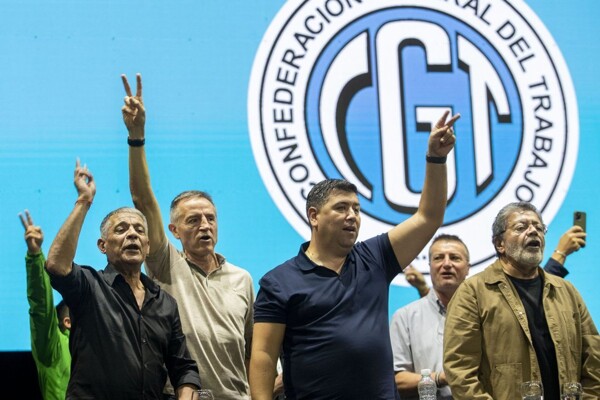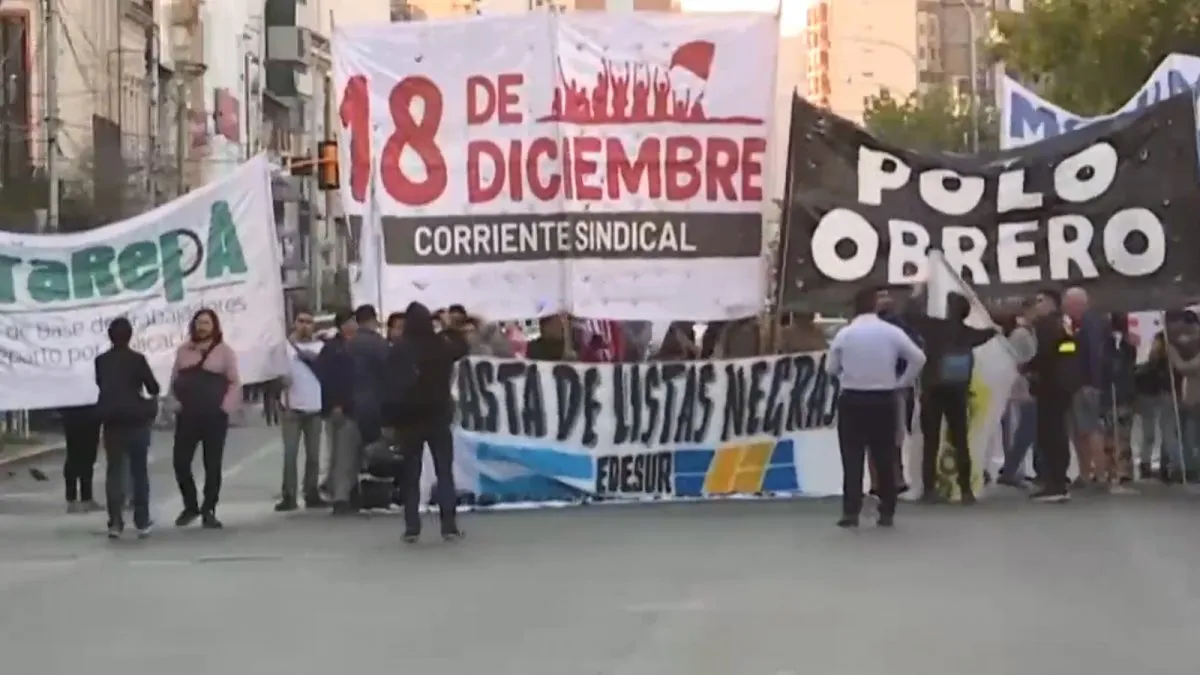
The Argentine government is facing, for the first time in many months, a simultaneous accumulation of political, judicial, and social wear and tear. In this context, the combination of union pressure, judicialization, and mobilization seeks to rebuild an opposition centrality that had been blurred for months by the libertarian shock. In parallel, social movements are also trying to regain a more prominent place in the confrontation with the ruling party. On the union front, the General Confederation of Labor (CGT) has strengthened its position by first obtaining an injunction that suspended a substantial part of the labor reform promoted by the government, although in recent hours the administration managed a judicial maneuver by moving that dispute to another jurisdiction that could review that suspension. Some express this with caution, others without euphemisms, as was the case with Peronist voices who have already openly stated that Milei should enter 2027 strongly. For Peronism and Kirchnerism, the case has a clear political virtue: it hits a very close official to the President, erodes the moral superiority discourse of the ruling party, and offers a meeting point for opposition sectors that until now had been fragmented. In the economy, the picture is more ambiguous and precisely for that reason it has become more exploitable for the opposition. The wear and tear generated by the Manuel Adorni case on different fronts, added to less linear economic signals than those shown by the Casa Rosada, have given air to sectors that are now seeking to show muscle again in the streets, in Congress, and also in the courts. The opposition conglomerate that gravitates around Kirchnerism, Peronism, hard-line unionism, social movements, and part of the territorial leadership began to detect a political window that until a few months ago seemed distant. Even with that open confrontation, the political signal has already been emitted: the CGT has repositioned itself as an actor of confrontation and the United Front of Unions called for a plenary of more than 1,500 delegates on May 1st, arguing to consolidate a common program against adjustment, salary decline, and job loss. The judicial investigation for alleged illicit enrichment, the measures on his trips and assets, the lifting of fiscal and banking secrecy ordered on the Chief of Staff and his wife, plus the citations and testimonies linked to the purchase of his apartment and the flight to Punta del Este, have fueled an agenda that the opposition tries to exploit relentlessly. In other words, there is no economic collapse, but there is enough noise for the opposition to try to install that the honeymoon period is over. That is the central point that today unites a heterogeneous opposition space: they do not necessarily share leadership, program, or method, but they do share the perception that the government is no longer immune. The big unknown is whether this air will be enough to build a real threat or if, once again, the opposition will clash with its own dispersion. In the Chamber of Deputies, the ruling party managed to block a request for an interpellation, but the issue has already fully entered the parliamentary debate and, at the same time, it recalibrates the internal dynamics of La Libertad Avanza in the City of Buenos Aires. The idea floating in those sectors is simple: if the government no longer looks invulnerable, it must be pushed on its most sensitive points. There is where the Adorni factor appears, today converted into the most uncomfortable political problem for the national administration. The CGT's call for a mobilization at Plaza de Mayo for April 30th, on the eve of Labor Day, appears as the most visible image of this attempt to regroup dispersed forces behind a common objective: to erode the government of Javier Milei and snatch the political initiative from him. The offensive is not only street-level. The closure of the 'Return to Work' program, the transition to voucher schemes, and the discussion about resources for the popular economy have reactivated protests, cuts, and assemblies, while UTEP and other organizations seek support from governors, mayors, and union structures so as not to remain encapsulated in a low-intensity protest. But this picture coexists with less favorable signals: inflation forecasts that would still take time to clearly break below 2%, tension in the provinces due to the drop in revenue, and a social climate in which Milei himself spoke of 'tough months' and asked for patience. Official data shows that activity is still growing: INDEC reported a year-on-year increase of 1.9% for January and a seasonally adjusted monthly advance of 0.4%. In this framework, the anti-Milei front seeks to ensure that the late-April march is not an isolated event but the beginning of a sequence of sustained pressure. February inflation also stood at 2.9%, far from the recent chaos, and the BCRA's REM projects an average growth of 3.3% for 2026, and it should be added that the BCRA achieved another favorable point, buying this week more than 400 million dollars. The Adorni scandal, the reordering of the union movement, the reactivation of social movements, and certain economic stumbles have given this universe a breath of fresh air it did not have.